
How it works
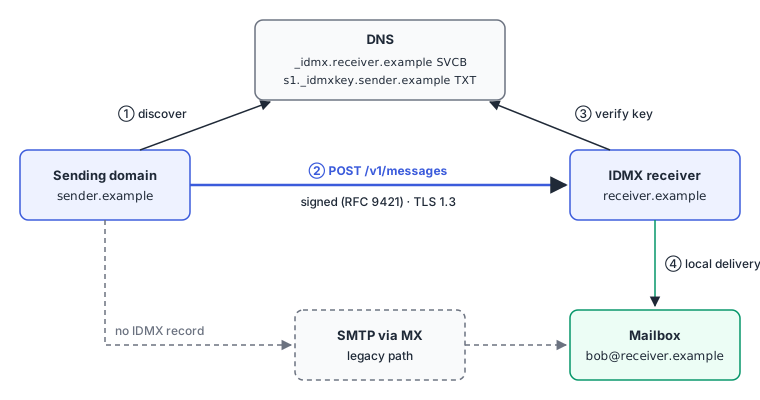
Here is what happens when alice@sender.example sends a message to bob@receiver.example.
1. Discover
Section titled “1. Discover”The sending domain looks up an SVCB record at _idmx.receiver.example. The record names the host
that accepts IDMX for that domain. That host can belong to a mail provider and be unrelated to the domain’s
website, just as MX records work today.
- No record: the domain does not support IDMX. The sender uses MX and SMTP as usual.
- A record: the sender fetches the receiver’s capabilities document (
GET /v1/capabilities). It lists the supported versions and limits such as the maximum message size, which is always at least 25 MiB.
After a successful discovery the sender pins the result, by default for 7 days. If a later DNS answer is missing or forged, the sender keeps using the pinned endpoint rather than silently downgrading to SMTP.
2. Sign and deliver
Section titled “2. Sign and deliver”The sender makes one HTTPS request per recipient domain: POST /v1/messages over TLS 1.3. The body
has two parts:
- a small JSON envelope with the sender and the recipients at that domain, and
- the message itself, the unchanged RFC 5322/MIME bytes, exactly as they would travel over SMTP.
The request carries an HTTP Message Signature (RFC 9421, Ed25519) made with the sending domain’s key, and an idempotency key. If the sender retries after a network error, the receiver recognizes the key and returns the original result instead of delivering twice.
3. Verify
Section titled “3. Verify”The receiver looks up the sender’s public key in DNS at <selector>._idmxkey.sender.example, a DKIM-style
record. Hosted providers can publish keys for their customers through a CNAME. If the signature does not
verify, the request is rejected, and the sender may not retry over SMTP.
4. Answer and hand off
Section titled “4. Answer and hand off”The response reports each recipient as accepted, rejected (for example, no such mailbox) or deferred (try again later). The receiver checks as much as it can before answering, so most failures are known immediately instead of bouncing hours later.
Accepted messages go to the receiver’s existing local delivery (LMTP, a pipe, whatever the MTA uses) with a
trace header and an Authentication-Results line. Mailbox storage and client access do not change.
When IDMX is unavailable
Section titled “When IDMX is unavailable”The spec separates “can’t reach IDMX” from “IDMX said no”:
- If the endpoint is unreachable or returns a server error, the sender retries with backoff. After a bounded fallback window of about 2 hours, it delivers over SMTP instead.
- An explicit rejection, such as an unknown recipient or a bad signature, is final. Falling back to SMTP would let a sender route around the receiver’s decision, so the spec forbids it.
Forwarding
Section titled “Forwarding”A domain that forwards a message (an alias, for example) sends it on as a new delivery signed by itself. The original author’s DKIM signature stays inside the message, so the next hop knows both who forwarded it and who wrote it.
The exact rules are in the specification.